|
| |
 |
| |
Shreis-Scalene Sciences
11516 Darnestown Rd. Gaithersburg,MD 20878
Tel : (001)301-926-0566
Fax : (001)301-926-2925
email : Shréis.com
|
|
|
 |
|
|
|
 |
Clinical Studies
Studies on
Arthritis
Effects of pulsed
electromagnetic fields on articular hyaline cartilage: review of
experimental and clinical studies
 Abstract Abstract
Osteoarthritis (OA) is the most common disorder of
the musculoskeletal system and is a consequence of mechanical and
biological events that destabilize tissue homeostasis in articular
joints. Controlling chondrocyte death and apoptosis, function,
response to anabolic and catabolic stimuli, matrix synthesis or
degradation and inflammation is the most important target of
potential chondroprotective treatment, aimed to retard or stabilize
the progression of OA. Although many drugs or substances have been
recently introduced for the treatment of OA, the majority of them
relieve pain and increase function, but do not modify the complex
pathological processes that occur in these tissues. Pulsed
electromagnetic fields (PEMFs) have a number of well-documented
physiological effects on cells and tissues including the
upregulation of gene expression of members of the transforming
growth factor b super family, the increase in glycosaminoglycan
levels, and an antiinflammatory action. Therefore, there is a strong
rationale supporting the in vivo use of biophysical stimulation with
PEMFs for the treatment of OA. In the present paper some recent
experimental in vitro and in vivo data on the effect of PEMFs on
articular cartilage were reviewed. These data strongly support the
clinical use of PEMFs in OA patients.
Modification
of osteoarthritis by pulsed electromagnetic field—a morphological
study
 Summary Summary
Objective: Hartley guinea pigs
spontaneously develop arthritis that bears morphological,
biochemical, and immunohistochemical similarities to human
osteoarthritis. It is characterized by the appearance of superficial
fibrillation by 12 months of age and severe cartilage lesions and
eburnation by 18 months of age. This study examines the effect of
treatment with a pulsed electromagnetic field (PEMF) upon the
morphological progression of osteoarthritis in this animal model.
Design:
Hartley guinea pigs were exposed to a specific PEMF for 1 h/day for
6 months, beginning at 12 months of age. Control animals were
treated identically, but without PEMF exposure. Tibial articular
cartilage was examined with histological / histochemical grading of
the severity of arthritis, by immunohistochemistry for cartilage
neoepitopes, 3B3(−) and BC-13, reflecting enzymatic cleavage
of aggrecan, and by immunoreactivity to collagenase (MMP-13) and
stromelysin (MMP-3). Immunoreactivity to TGFβ, interleukin
(IL)-1β, and IL receptor antagonist protein (IRAP) antibodies
was examined to suggest possible mechanisms of PEMF activity.
Results:
PEMF treatment preserves the morphology of articular cartilage and
retards the development of osteoarthritic lesions.
This observation is supported by a reduction in the cartilage
neoepitopes, 3B3(−) and BC-13, and suppression of the
matrix-degrading enzymes,collagenase and stromelysin. Cells
immunopositive to IL-1 are decreased in number, while IRAP-positive
cells are increased in response totreatment. PEMF treatment markedly
increases the number of cells immunopositive to TGFβ.
Conclusions: Treatment with PEMF appears to be
disease-modifying in this model of osteoarthritis. Since
TGFβ is believed to upregulate gene expression for aggrecan,
downregulate matrix metalloprotease and IL-1 activity, and
upregulate inhibitors of matrix metalloprotease,the stimulation of
TGFβ may be a mechanism through which PEMF favorably
affects cartilage homeostasis.
Proteoglycan
synthesis in bovine articular cartilage explants exposed to
different low-frequency low-energy pulsed electromagnetic fields
 Summary Summary
Objective: To investigate the role of pulsed electromagnetic field (PEMF)
exposure parameters (exposure length, magnetic field peak amplitude,
pulse frequency) in the regulation of proteoglycan (PG) synthesis of
bovine articular cartilage explants.
Methods: Bovine articular cartilage explants were exposed to a PEMF
(75 Hz; 2 mT) for different time periods: 1, 4, 9, 24 h. Then,
cartilage explants were exposed for 24 h to PEMFs of different
magnetic field peak amplitudes (0.5, 1, 1.5, 2 mT) and different
frequencies (2, 37, 75, 110 Hz). PG synthesis of control and exposed
explants was determined by Na2-35SO4 incorporation.
Results: PEMF exposure significantly increased PG synthesis ranging
from 12% at 4 h to 17% at 24 h of exposure. At all the magnetic
field peak amplitude values, a significant PG synthesis increase was
measured in PEMF-exposed explants compared to controls, with maximal
effect at 1.5 mT. No effect of pulse frequency was observed on PG
synthesis stimulation.
Conclusions: The results of this study show the range of exposure
length, PEMF amplitude, pulse frequency which can stimulate
cartilage PG synthesis, and suggest optimal exposure parameters
which may be useful for cartilage repair in in vivo experiments and
clinical application.
Pulsed
Electromagnetic Fields for Treating Osteo-arthritis
 Summary Summary
Background Osteo-arthritis, a
painful joint disorder involving degenerative changes of the
articular cartilage and subchondral bone, often results in
progressive functional impairment and disability. One particular
modality used by physiotherapists that shows very promising results
in reducing the joint damage and pain found in osteo-arthritis is
pulsed
electromagnetic fields.
Objective The present objective was to examine the
rationale for, and the potential efficacy of, applying pulsed
electromagnetic fields for reducing joint pain and other related
symptoms of osteo-arthritis.
Methods The related English language literature was
extensively reviewed to examine whether changes in pain might be
expected from the application of pulsed electromagnetic fields to an
osteo-arthritic joint, and why.
Results The basic and clinical research in this
field, while somewhat limited, supports the insightful application
of pulsed electromagnetic fields to ameliorate pain and disability
due to osteo-arthritis.
Conclusion Further basic and clinical research to
validate the use of pulsed electromagnetic fields in facilitating
function and possibly in facilitating joint reparative processes in
osteo-arthritis, as well the lessening of osteo-arthritic joint pain
and joint dysfunction is indicated.
Indian
Journal of Aerospace Medicine : 48(2) 2004
Rotational
Field Quantum Magnetic Resonance (RFQMR) in the Treatment of Osteo
Arthritis of the Knee Joint

Studies
on Cancer
NMR exposure sensitizes tumor cells to apoptosis
 NMR
technology has dramatically contributed to the revolution of image
diagnostic. NMR apparatuses use combinations of microwaves over a
homogeneous strong (1 Tesla) static magnetic field. We had
previously shown that low intensity (0.3–66 mT) static magnetic
fields deeply affect apoptosis in a Ca2+ dependent fashion (Fanelli
et al., 1999 FASEBJ., 13;95–102). The rationale of the present
study is to examine whether exposure to the static magnetic fields
of NMR can affect apoptosis induced on reporter tumor cells of
haematopoietic origin. The impressive result was the strong
increase (1.8–2.5 fold) of damage-induced apoptosis by NMR.
This potentiation is due to cytosolic Ca2+ overload consequent to
NMR-promoted Ca2+ influx, since it is prevented by intracellular (BAPTA-AM)
and extracellular (EGTA) Ca2+ chelation or by inhibition of plasma
membrane L-type Ca2+ channels. Three-days follow up of treated
cultures shows that NMR decrease long term cell survival, thus
increasing the efficiency of cytocidal treatments. Importantly,
mononuclear white blood cells are not sensitised to apoptosis by NMR,
showing that NMR may increase the differential cytotoxicity of
antitumor drugs on tumor vs normal cells. This strong,
differential potentiating effect of NMR on tumor cell apoptosis may
have important implications, being in fact a possible adjuvant for
antitumor therapies. NMR
technology has dramatically contributed to the revolution of image
diagnostic. NMR apparatuses use combinations of microwaves over a
homogeneous strong (1 Tesla) static magnetic field. We had
previously shown that low intensity (0.3–66 mT) static magnetic
fields deeply affect apoptosis in a Ca2+ dependent fashion (Fanelli
et al., 1999 FASEBJ., 13;95–102). The rationale of the present
study is to examine whether exposure to the static magnetic fields
of NMR can affect apoptosis induced on reporter tumor cells of
haematopoietic origin. The impressive result was the strong
increase (1.8–2.5 fold) of damage-induced apoptosis by NMR.
This potentiation is due to cytosolic Ca2+ overload consequent to
NMR-promoted Ca2+ influx, since it is prevented by intracellular (BAPTA-AM)
and extracellular (EGTA) Ca2+ chelation or by inhibition of plasma
membrane L-type Ca2+ channels. Three-days follow up of treated
cultures shows that NMR decrease long term cell survival, thus
increasing the efficiency of cytocidal treatments. Importantly,
mononuclear white blood cells are not sensitised to apoptosis by NMR,
showing that NMR may increase the differential cytotoxicity of
antitumor drugs on tumor vs normal cells. This strong,
differential potentiating effect of NMR on tumor cell apoptosis may
have important implications, being in fact a possible adjuvant for
antitumor therapies.
Effects of Pulsed Magnetic Stimulation onTumor Development and
Immune Functions in Mice
 We
investigated the effects of pulsed magnetic stimulation on tumor
development processes and immune functions in mice. A circular coil
(inner diameter¼15 mm, outer diameter¼75 mm) was used in the
experiments. Stimulus conditions were pulse width¼238 ms, peak
magnetic field¼0.25 T We
investigated the effects of pulsed magnetic stimulation on tumor
development processes and immune functions in mice. A circular coil
(inner diameter¼15 mm, outer diameter¼75 mm) was used in the
experiments. Stimulus conditions were pulse width¼238 ms, peak
magnetic field¼0.25 T
(at the center of the coil), frequency¼25 pulses/s, 1000
pulses/sample/day and magnetically induced eddy currents in mice¼0.79–1.54
A/m2. In an animal study, B16-BL6 melanoma model mice were exposed
to the pulsed magnetic stimulation for 16 days from the day of
injection of cancer cells. A tumor growth study revealed a
significant tumor weight decrease in the stimulated group (54%
of the sham group). In a cellular study, B16-BL6 cells were also
exposed to the magnetic field (1000 pulses/sample, and eddy currents
at the bottom of the dish¼2.36–2.90 A/m2); however, the
magnetically induced eddy currents had no effect on cell
viabilities. Cytokine production in mouse spleens was measured to
analyze the immunomodulatory effect after the pulsed magnetic
stimulation.
Tumor necrosis factor (TNF-a) production in mouse spleens was
significantly activated after the exposure of the stimulus condition
described above. These results showed the first evidence of
the antitumor effect and immunomodulatory effects brought about by
the application of repetitive magnetic stimulation and also
suggested the possible relationship between anti-tumor effects and
the increase of TNF-a levels caused by pulsed magnetic stimulation.
EXTREMELY LOW FREQUENCY
(ELF) PULSED-GRADIENT MAGNETIC FIELDS INHIBIT MALIGNANT TUMOUR
GROWTH AT DIFFERENT BIOLOGICAL LEVELS
 Extremely
low frequency (ELF) pulsed-gradient magnetic field (with the maximum
intensity of Extremely
low frequency (ELF) pulsed-gradient magnetic field (with the maximum
intensity of
0.6–2.0 T, gradient of 10–100 T · M_1, pulse width of 20–200
ms and frequency of 0.16–1.34 Hz treatment of mice can inhibit
murine malignant tumour growth, as seen from analyses at
different hierarchical levels, from organism, organ, to tissue, and
down to cell and macromolecules.
Such magnetic fields induce apoptosis of cancer cells, and
arrest neoangiogenesis,
preventing a supply developing to the tumour. The
growth of sarcomas might be amenable to such new method of
treatment.
Increasing
cell membrane potential and GABAergic activity inhibits malignant
hepatocyte growth
 Increasing
hepatocyte membrane potentials by augmenting GABAergic activity
inhibits nonmalignant hepatocyte proliferative activity. The
objectives of this study were to document 1) potential
differences (PDs) of four malignant hepatocyte cell lines, 2)
GABAA receptor mRNA expression in the same cell lines, and 3)
effects of restoring malignant hepatocyte PDs to levels
approximating those of resting, nonmalignant hepatocytes. Hepatocyte
PDs were documented in nonmalignant and malignant (Chang, HepG2,
HuH-7, and PLC/PRF/5) hepatocytes with a fluorescent
voltage-sensitive dye and GABAA receptor expression by RT-PCR and
Western blot analyses.Compared with nonmalignant human hepatocytes,
all four malignant cell lines were significantly depolarized (P _0.0001,
respectively). Only PLC/PRF/5 cells had detectable GABAA-_3 receptor
mRNA expression and all cell lines were negative for GABAA-_3
receptor protein by Western blot analysis. Stable transfection of
Chang cells with GABAA-_3 receptor cDNA resulted in significant
increases in PD and decreases in proliferative activity as manifest
by decreased [3H]thymidine and bromodeoxyurieine incorporation
rates, 4-[3-(4-lodophenyl)-2-(4-nitrophenyl)-2H-5-tetrazolio]-1,3-
benzene disulfonate activity, a lower mitotic index, prolongation of
cell-doubling times, and attenuated growth patterns compared with
cells transfected with vector alone. Colony formation in soft agar
and the number of abnormal mitoses were also significantly decreased
in GABAA-_3 receptor transfected cells. The results of this
study indicate 1) relative to healthy hepatocytes,
malignant hepatocytes are significantly depolarized, 2)
GABAA-_3 receptor expression is absent in malignant hepatocyte cell
lines, and 3) increasing the PD of malignant hepatocytes is
associated with less proliferative activity and a loss of malignant
features. Increasing
hepatocyte membrane potentials by augmenting GABAergic activity
inhibits nonmalignant hepatocyte proliferative activity. The
objectives of this study were to document 1) potential
differences (PDs) of four malignant hepatocyte cell lines, 2)
GABAA receptor mRNA expression in the same cell lines, and 3)
effects of restoring malignant hepatocyte PDs to levels
approximating those of resting, nonmalignant hepatocytes. Hepatocyte
PDs were documented in nonmalignant and malignant (Chang, HepG2,
HuH-7, and PLC/PRF/5) hepatocytes with a fluorescent
voltage-sensitive dye and GABAA receptor expression by RT-PCR and
Western blot analyses.Compared with nonmalignant human hepatocytes,
all four malignant cell lines were significantly depolarized (P _0.0001,
respectively). Only PLC/PRF/5 cells had detectable GABAA-_3 receptor
mRNA expression and all cell lines were negative for GABAA-_3
receptor protein by Western blot analysis. Stable transfection of
Chang cells with GABAA-_3 receptor cDNA resulted in significant
increases in PD and decreases in proliferative activity as manifest
by decreased [3H]thymidine and bromodeoxyurieine incorporation
rates, 4-[3-(4-lodophenyl)-2-(4-nitrophenyl)-2H-5-tetrazolio]-1,3-
benzene disulfonate activity, a lower mitotic index, prolongation of
cell-doubling times, and attenuated growth patterns compared with
cells transfected with vector alone. Colony formation in soft agar
and the number of abnormal mitoses were also significantly decreased
in GABAA-_3 receptor transfected cells. The results of this
study indicate 1) relative to healthy hepatocytes,
malignant hepatocytes are significantly depolarized, 2)
GABAA-_3 receptor expression is absent in malignant hepatocyte cell
lines, and 3) increasing the PD of malignant hepatocytes is
associated with less proliferative activity and a loss of malignant
features.
Carcinogenesis and the plasma membrane
 Summary Summary
Presented is a two-stage hypothesis of carcinogenesis based on: (1)
plasma membrane defects that produce abnormal electron and proton
efflux; and (2) electrical uncoupling of cells through loss of
intercellular communication. These changes can be induced by a wide
variety of stimuli including chemical carcinogens, oncoviruses,
inherited and/or acquired genetic defects, and epigenetic
abnormalities. The resulting loss of electron/proton homeostasis
leads to decreased transmembrane potential, electrical
microenvironment alterations, decreased extracellular pH, and
increased intracellular pH. This produces a positive feedback loop
to enhance and sustain the proton/electron efflux and loss of
intercellular communication. Low transmembrane potential is
functionally related to rapid cell cycling, changes in membrane
structure, and malignancy. Intracellular alkalinization
affects a variety of pH-sensitive systems including glycolysis, DNA
synthesis, DNA transcription and DNA repair, and promotes genetic
instability, accounting for the accumulation of genetic defects seen
in malignancy. The abnormal microenvironment results in the
selective survival and proliferation of malignant cells at the
expense of contiguous normal cell populations.
Contact inhibition of division: Involvement of the
electrical transmembrane potential
Clarence D. Cone , Max Tongier Journal of Cellular Physiology Volume
82, Issue 3, Pages 373 - 386
Measurements of simultaneous mitotic activity, electrical
transmembrane potential (Em), and cell density levels in both 3T3
and Chinese hamster ovary (CHO) cell cultures reveal that a 5- to
6-fold increase in the Em level is associated with development of
mitotic arrest at saturation densities. This rise occurs both in
confluent monolayers and in interior areas of isolated colonies, and
is independent of the rate at which confluence is attained. The Em
rise is accompanied by a substantial decrease in intracellular Na.
Electron microscopy of saturated CHO monolayer sections shows from
46 to 63% of the cell surfaces to be in close apposition (<300 Å
spacing). These results for contact inhibited cultures support the
hypothesis that mitotic activity may be functionally coupled with
the Em level and associated ionic concentration levels. It is
suggested that contact inhibition of mitosis may result from a
reduction in synthesis of mitogenically essential RNA following a
decrease in intracellular Na produced by contact-induced alteration
of surface ion-transport activity
Cellular potentials of normal and cancerous fibroblasts
and hepatocytes.
Binggeli R, Cameron IL Cancer Research 1980
Jun;40(6):1830-5.
Several lines of investigation point to differences in electrical
properties between normal and cancerous cells. Several tumor lines
have low-resting membrane potentials. A few comparisons have been
made between normal and tumor cells within the same tissue cell
type. This study compares the cellular or transmembrane potential of
hepatocytes and fibroblasts in both normal and tumor cells.
High-impedance micropipets were used to record intracellularly in
vivo in Buffalo rat hepatocytes and Morris 7777 hepatoma cells, as
well as A/J mouse corneal fibroblasts and poorly differentiated
fibrosarcoma cells. Rat hepatocytes had a mean membrane potential of
-37.1 +/- 4.3 (S.D.) mV compared to -19.8 +/- 7.1 mV in the hepatoma
cells. Mouse corneal fibroblasts measured -42.5 +/- 5.4 mV, while
cells of mouse fibrosarcoma were -14.3 +/- 5.4 mV. The
membrane potentials of the tumor cells were lower in both instances
than in their normal counterpart (statistically significant at p =
0.001 for both tissue cell types). This supports the notion that
lower cellular or membrane potentials may play a significant role in
the altered physiology of the tumor cell.
Deficits in elevating membrane potential of rat
fibrosarcoma cells after cell contact
Binggeli R, Weinstein RC Cancer Research 1985
Jan;45(1):235-41.
Most cancer cells are known to have lower resting
cellular potentials than do their normal counterparts. This
study investigates how these potentials establish themselves during
growth and cellular contact in tissue culture. Normal quail
embryonic fibroblasts and quail fibrosarcoma (QT-35) and normal rat
kidney cells and rat fibrosarcoma (from rat fibroblasts chemically
transformed by nitroquinoline oxide) were recorded intracellularly
using high-impedance micropipets. In high-density high-contact
cultures, both quail and rat cancer cells had lower potentials than
did normal cells (-20.7 compared to -40.1 mV for quail and -30.7
compared to -61.9 mV for rat). In low-density mitotically
synchronous cultures, the rat cells were recorded every 4 hr for 96
hr. Starting at a low density, normal cell membrane potential is
maintained at a low level through subsequent cell divisions. Without
any additional change in cell density, the potential suddenly
elevates to a high level. The membrane potential of cancer cells is
by contrast unrelated either to cell density or to time. Cancer
cells maintained an intermediate potential from low to very high
densities and never elevated their potential to high values. The
failure of cancer cells to reach high potentials may be linked to
their uncontrolled cell division.
Calcium ion and the membrane potential of tumor cells
Binggeli R, Weinstein RC, Stevenson D Cancer Biochemisry
Biophysics 1994 Oct;14(3):201-10.
Calcium ion affects ion permeability and membrane potential among
many other aspects of cell function. Initial effects of increasing
extracellular calcium upon membrane potential were studied in a
quail fibrosarcoma (QT35) where calcium had a dose dependent effect,
and normal quail fibroblasts, where there was little effect.
Comparisons were then made in six different human hepatocellular
carcinomas (Tong, HepG2, Hep3B, PLC/PRF/5, Mahlavu, and HA22T) in
response to smaller changes in concentration. There were
insignificant changes in membrane potential in two cell lines and
significant elevations in four. Cytolysis by natural killer cells
also declined in rough proportion to the increase in membrane
potential. The less differentiated hepatocellular carcinoma cells
have both higher baseline membrane potentials and a greater
potential increase to increased calcium. By contrast, more highly
differentiated tumor cells had paradoxically smaller membrane
potentials and along with normal cells had small potential responses
to calcium increases.
Therapeutic Uses of Pulsed Magnetic Field Exposure – A Review
Low Energy Pulsing Electromagnetic Fields
Modify Biomedical Processes
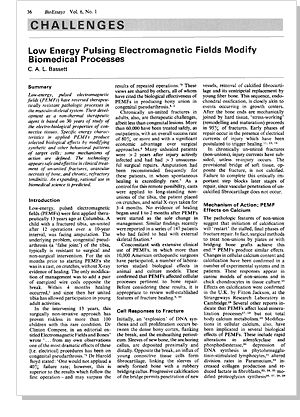 Summary Summary
Low-energy, pulsed electromagnetic fields (PEMFs) have reversed
therapeutically resistant pathologic processes in the musculo-skeletal
system. Their development as a non-thermal therapeutic agent is
based on 30 years of study of the electro-biological properties of
connective tissues. Specific energy characteristics in applied PEMFs
produce selected biological effects by modifying synthetic and other
behavioral patterns of target cells; some mechanisms of action are
defined. The technology appears safe and effective in clinical
treatment of un-united fractures, avascular necrosis of bone, and
chronic, refractory tendinitis. An expanding, rational use in
biomedical science is predicted.
|
|
|





 Shreis-Scalene