|
CANCER
Osteo
Arthritis
In which
types of cancer is RFQMR applicable ?
RFQMR treatment can be applied locally on tumors
not to the body general as a systemic treatment. Three
different tumors in close regions can be targeted
simultaneously. In wide spread metastasis, in leukemia and
skin cancers RFQMR can not be used. During the clinical trials, best outcome has been
observed on brain tumors, pancreatic cancer, non small cell
lung cancer, liver cancer, kidney cancer, colon cancer,
ovarian cancer, prostate cancer and laryngeal cancer. Currently there in not enough clinical evidence that
RFQMR should be used in breast cancer, bone cancer,
lymphoma, non small cell lung cancer, sarcoma, head and neck
cancer.
Top
What
is the effect of RFQMR on the tumors and on the overall
disease condition?
In those patients responding to the treatment
within the first week there is a significant reduction in
tumor activity accompanied by a decrease in the intensity of
pain and most patients are able to stop taking painkillers
including morphine. As of the second week the appetite comes
back, and also an increase in the overall energy level and
weight gain is expected. The major aim of the RFQMR therapy is not the immediate
destruction of the tumor but rather suppressing the growth
and activity. Following the treatment the cancer cells gets
into a vegetative state and in time the programmed cell
death –apoptosis- takes place. After the treatment what is
expected is that the borders of the tumors should be more
defined, the tumor density should be reduced, the tumor
activity should halt, and there is some shrinkage and
subsequent volume reduction of the tumor. Athough a long
period is required for the complete elimination of the
tumor, the inactivated tumor mass does not pose any further
health risks.
Top
Can
RFQMR be used along with other therapies for cancer?
Currently the recognized modalities for cancer
treatment are surgery, radiotherapy and chemotherapy. RFQMR
should never be substituted for a treatment advised by a
competent doctor for the patient. Nevertheless in those
patients that do not respond to conventional therapies, and
in such patients where the efficacy of the conventional
therapies need to be enhanced RFQMR can be used along with
other treatment modalities. If applied prior to the surgery, the borders of tumor
will be more defined and the activity will be less so the
surgery could be more precisely undertaken. Also future
metastasis and recurrence could be prevented. Post
surgery RFQMR may be used to control the remainder of the
tumors that may not be fully cleared during the surgery.
Combined with chemotherapy RFQMR may help to control the
tumors more effectively in the applied area. As it
works through different mechanisms RFQMR can be used along
with other Complementary or Alternative Therapies.
Top
How does the
RFQMR cancer treatment process takes places?
In order to determine the suitability of the RFQMR
treatment we need to obtain a dossier that contains
personalized information of the patient such as age, sex,
weight etc, the diagnosis and the prognosis of the disease
based on previous investigations, therapies applied and the
outcome, the current situation of the patient with detailed
symptoms, test results and the diagnostic images such
as MRI, CT Scan, X-Ray etc (preferably in DICOM format on a
CD). There will be an initial evaluation of the patient, and
if RFQMR is applicable there will be a further appointment
with our doctors to discuss the terms and expected outcomes
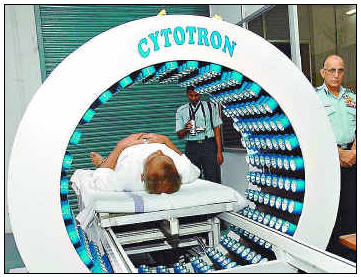
of the treatment. Prior to the treatment the MRI of the area where
treatment will be focused is obtained and will be fed to the
Cytotron system. Afterwards based on the proton density of
the tumors the system will make an automated dose planning.
Depending on the size and type of the tumor and patient’s
overall health condition the treatment will be made either
as a 28 days 1 hour session or 14 days on 14 days break 14
days on session. If deemed necessary, the chemotherapy along
with the RFQMR treatment will be provided under the
supervision of our Oncologist.
Top
Is there a
side effect of RFQMR treatment on cancer patients?
No significant side effect has been noticed in the
patients that participated in the Phase 1 clinical
trial. In very few patients minor issues such as temporary
redness itching has been observed. The patient does not feel
anything during the treatment. RFQMR does not utilize the ionizing, thermal, destructive
radiation of the upper side of the electromagnetic spectrum
such those used in radiotherapy including X-rays or gamma
knife that damages the DNAs and may also adversely affect
the healthy cells. The non-ionizing, non-thermal radio
frequency waves utilized in RFQMR has been safely used in
thousands of electrical devices for more that 100 years and
the MRI technology that has been utilized to precisely focus
the rays on the application area has been in wide spread use
for more than 30 years. In order to prevent the adverse
affects that may take place do to the rapid necrosis of the
dying tumor, the treatment can be split into two if
necessary.
Top
In which
types of arthritis is RFQMR applicable?
The RFQMR treatment has been applied to
osteoarthritis patients on the clinical trials. Mostly
conditions related to a damaged or detoriated cartilage
responds best to RFQMR treatment. Although positive
responses has been noticed on patients with Rheumatoid
arthritis, the long term success of this improvement is
currently unknown as the number and the duration is limited.
There is no direct effect of RFQMR on ligaments, meniscuses
or thorn muscles. However once the joint’s condition is
improved with treated cartilage further benefits can be
obtained with the help of physiotherapy where the strength
of the muscle groups can be improved. Currently the RFQMR
can be applied on both knees, or hips, or shoulders, or
elbows.
Top
What is the
effect of RFQMR on cartilage and the overall condition of
the joint?
In patients responding the treatment, there is a
noticeable reduction in pain and improvement in mobility
after 10-15 sessions. By the end of 21 sessions most
patients should be free of pain and not requiring any pain
killers. There is a significant improvement in joint
mobility. Even patients who can hardly walk a few steps or
those who are bedridden may walk longer distances without
pain. But yet the overall efficacy is based on several
factors including other conditions that may affect the
joint. The regenerative effect of RFQMR on cartilage is expected
to continue once the treatment period is over. The 21 day
sessions are required to initiate the regeneration process
by increasing the membrane potential of the cells to a level
where command and control center can issue orders for cell
division. During the clinical trials measurable
regeneration has been observed on MRI scans 90 days post
treatment period and this situation continues even nine
months after the treatment is over. As a result continual
improvement is expected for a considerable time frame.
Top
How
does the RFQMR arthritis treatment process takes place?
In order to determine the suitability of the RFQMR
treatment we need to obtain a dossier that contains
personalized information of the patient such as age, sex,
weight etc, the diagnosis and the prognosis of the disease
based on previous investigations, therapies applied and the
outcome, the current situation of the patient with detailed
symptoms, test results and the diagnostic images such
as MRI, X-Ray etc (preferably in DICOM format on a
CD). There will be an initial evaluation of the patient, and
if RFQMR is applicable there will be a further appointment
with our doctors to discuss the terms and expected outcomes
of the treatment. Prior to the treatment the MRI of the area where
treatment will be focused is obtained and will be fed to the
Cytotron system. Afterwards the system will make an
automated dose planning.The therapy will take place as a
continuous 21 day sessions of 30 minutes each for knee and
60 minutes each for hip osteoarthritis patients.
Top
Is
there a side effect of RFQMR treatment on arthritis
patients?
Over the last 3 years no significant side effect
has been noticed in the patients that
participated in the clinical trials and obtained treatment.
In very few patients minor issues such as temporary redness
itching has been observed. The patient does not feel
anything during the treatment.
RFQMR does not utilize the ionizing, thermal, destructive
radiation of the upper side of the electromagnetic spectrum
such those used in radiotherapy including X-rays or gamma
knife that may also adversely affect the healthy cells. The
non-ionizing, non-thermal radio frequency waves utilized in
RFQMR has been safely used in thousands of electrical
devices for more that 100 years and the MRI technology that
has been utilized to precisely focus the rays on the
application area has been in wide spread use for more than
30 years.
Top
Is
RFQMR treatment available in the USA?
Shréis-Scalene Sciences is responsible for all distribution,
scientific set ups, collaborations etc in the USA, Canada,
and South American Countries. Since the CE Mark
Certification and European patent has been in
Europe, the devices too are avilable in Europe. . Clinical trials are about to commence in Mexico. Shreis will be working with Mexican COFEPRIS for the Mexican trials and also with the US FDA to initiate the clinical trials in USA.
Top
|